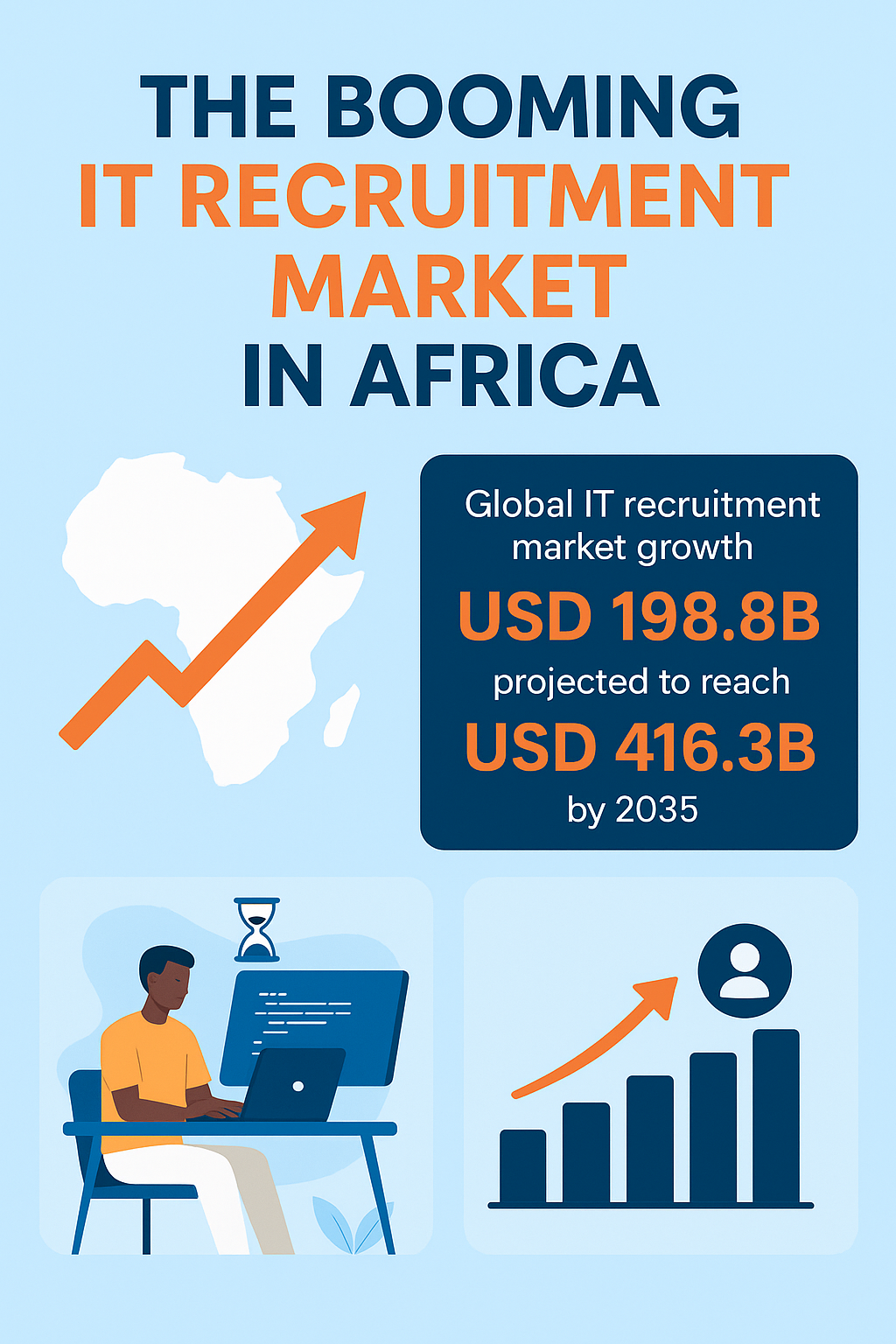
1. Africa’s Digital Transformation Is Driving Unprecedented Demand
From Nairobi’s “Silicon Savannah” to Lagos’ booming fintech scene and Cape Town’s innovation hubs, African economies are undergoing a deep digital shift.
Governments and private enterprises alike are investing heavily in technology infrastructure, digital payments, and data services.
The African Development Bank projects the continent’s digital economy will reach USD 712 billion by 2050, creating millions of tech-related jobs.
In Kenya alone, ICT contributes nearly 10% of GDP and continues to grow by double digits each year.
Nigeria’s tech ecosystem, now valued at over USD 14 billion, is producing world-class software engineers and data scientists for both local and international markets.
This rapid transformation has created a fierce race for talent — and a unique opportunity for recruitment firms to help bridge the gap between skills supply and demand.
2. The Skills Shortage: A Continental Challenge with Global Potential
While Africa boasts one of the world’s youngest workforces, a significant portion of its potential remains underdeveloped.
The World Economic Forum predicts that by 2030, Africa will account for one-third of the global youth population, yet many lack access to specialised digital training.
This mismatch is shaping IT recruitment in several key ways:
High competition for senior tech talent: Experienced software engineers, cybersecurity experts, and cloud architects are in short supply.
Growing need for reskilling: Employers are investing in training and certification programmes to build home-grown expertise.
Rising global outsourcing interest: International companies are turning to African talent to fill remote IT roles, attracted by cost-efficiency and growing skill quality.
For recruitment agencies, this trend highlights the importance of developing technical specialisation and regional talent mapping capabilities.
3. Remote Work: Africa’s Gateway to the Global Tech Economy
The rise of remote work has revolutionised Africa’s IT recruitment landscape.
Today, a developer in Nairobi can work for a startup in Berlin or a data analyst in Accra can support a U.S. fintech firm — without leaving their home country.
According to AfricArena’s 2025 Tech Talent Report, remote and hybrid roles now represent over 40% of all tech vacancies advertised in major African markets.
Platforms like Andela, Gebeya, and Turing have connected thousands of African software developers to international employers.
Countries such as Kenya, Egypt, and South Africa are becoming recognised remote talent hubs, offering skilled labour at globally competitive rates.
For employers, this trend opens vast talent pipelines. For candidates, it means access to global opportunities, competitive salaries, and exposure to international projects.
4. The Rise of Recruitment Technology and AI-Driven Hiring
Recruitment itself is being transformed by technology.
African hiring firms are adopting AI-based candidate matching, automated screening tools, and video-interview platforms to streamline the hiring process and improve accuracy.
A 2025 survey by SHRM Africa found that 38% of African HR leaders are now using AI in recruitment — a figure expected to surpass 50% by 2026.
Tools such as HireVue, Zoho Recruit, and Manatal are being customised for local use, integrating regional compliance and data-protection frameworks.
However, experts caution that AI should complement — not replace — human judgment. Ensuring fairness, transparency, and cultural understanding remains critical in Africa’s diverse hiring landscape.
5. Niche Skills and Sector Specialisation Are Redefining Hiring
The most in-demand IT roles in Africa today mirror global trends but with regional nuances.
According to Microsoft Africa’s 2025 Digital Skills Report, top hiring areas include:
Cloud engineering (Azure, AWS, GCP)
Cybersecurity and digital forensics
AI and machine learning
Fintech and blockchain development
Data science and analytics
Mobile application development
Recruitment firms that specialise in these high-growth domains are seeing the strongest demand from both local corporates and global clients seeking African talent.
6. Employer Branding and Candidate Experience Matter More Than Ever
African tech professionals are becoming increasingly selective about where they work.
Beyond salary, they prioritise career development, flexibility, and company culture.
A 2025 LinkedIn Africa study revealed that 74% of IT professionals will not pursue opportunities with employers who have poor reputations for employee wellbeing or unclear career growth.
For companies, this means recruitment is no longer just about filling roles — it’s about selling a vision.
Authentic employer branding, clear communication, and a strong learning culture now define competitive advantage.
7. Outlook: The Future of IT Recruitment in Africa
The next decade will be transformative. Key predictions include:
Regional specialisation: Kenya and Rwanda will continue leading in cloud and AI innovation; Nigeria and Ghana will dominate fintech and software engineering; South Africa will remain a hub for enterprise IT and cybersecurity.
Growth of recruitment outsourcing (RPO): More companies will partner with specialist agencies to manage end-to-end hiring, compliance, and onboarding.
Expansion of digital talent academies: Public-private partnerships will invest in training, bridging the skills gap and supporting youth employment.
Rise of pan-African remote teams: Multinational firms will hire distributed teams across Africa to build scalable, cost-efficient operations.
In short, Africa is not only filling the global IT talent gap — it’s becoming a strategic engine of innovation for the world’s digital economy.